
Walking through hair expos or browsing Alibaba, you’ll see it everywhere: “5A Grade”, “6A Grade”, “7A Grade” raw hair. But what does it actually mean? Is 7A really better than 5A? Or is it just clever marketing?
Today, we’re pulling back the curtain. As a factory that’s been grading raw human hair bundles since 2007, we’ll give you the unfiltered truth about hair grading systems.
The Short Answer: There Is No Universal Standard
Let’s get this out of the way first: Hair grades (5A, 6A, 7A) are NOT regulated. Unlike organic food (USDA certified) or diamonds (GIA graded), there’s no global authority that defines what “7A” means.
Each factory, each supplier, each region can (and does) define grades differently. A “7A” from one supplier might be equivalent to “5A” from another. Confusing? Absolutely. But that’s the reality of the raw hair industry.
So why do grades exist? Two reasons:
- Marketing: “7A” sounds better than “5A”, so suppliers can charge more.
- Internal Sorting: Factories use grades to sort hair by quality (more on this below).
At Honest Hair Factory, we don’t use the A-grade system. We grade our Thai raw hair based on measurable criteria: cuticle alignment, hair source, and durability testing. But since the market uses A-grades, let’s break down what they *typically* mean.
Typical Grade Definitions (Industry Consensus)
| Grade | Typical Characteristics | Expected Lifespan |
|---|---|---|
| 5A | Remy hair, cuticles aligned, may have slight processing | 3-6 months |
| 6A | Virgin hair, no chemical processing, single donor | 6-9 months |
| 7A | Premium virgin hair, double-wefted, thick ends | 9-12 months |
| 8A/9A/10A | Marketing terms, often same as 7A but higher price | Same as 7A (if legit) |
Notice I said “typical”? That’s because there’s no guarantee. We’ve tested “7A” hair from 10 different suppliers – the quality varied wildly. Some was genuinely premium; others was 5A at best.
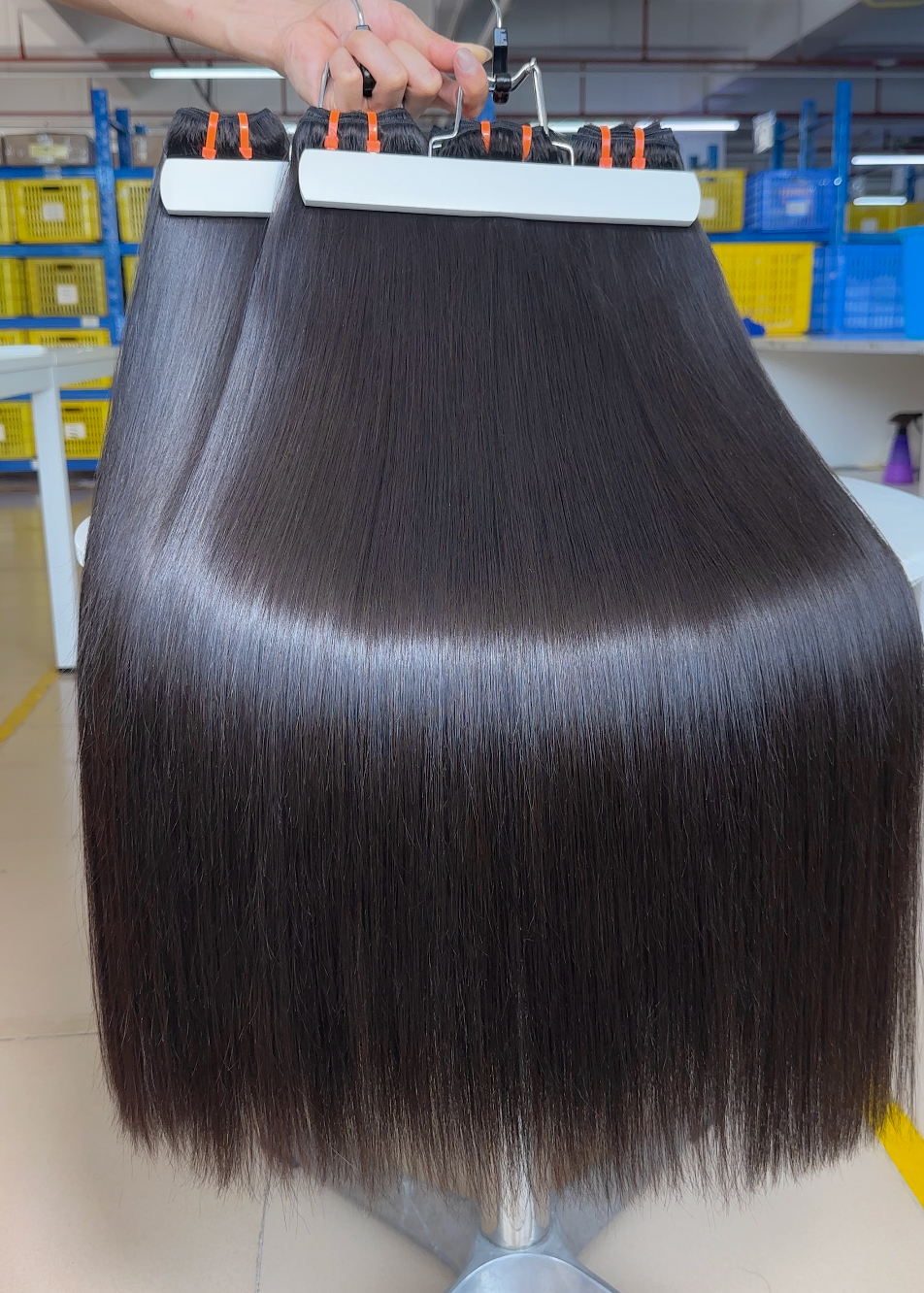
Click image to view our premium raw human hair bundles
How Factories ACTUALLY Grade Hair (Behind the Scenes)
Forget the marketing brochures. Here’s how reputable factories (like ours) actually sort raw hair:
Step 1: Source Verification
Where did the hair come from? Temple donations (India/Thailand) vs. salon collections vs. fallen hair (combed from floors). Temple hair is highest quality because:
- Single Donor: Often from one person (or same age group).
- Healthier Hair: Donors don’t use harsh chemicals before offering.
- Uniform Texture: Easier to match within a batch.
Our Thai Hair is 100% temple-collected. We know the exact temple, collection date, and even the approximate age range of donors. That’s traceability you won’t get with “5A” mystery hair.
Step 2: Cuticle Alignment Test
Take 20 strands from a bundle. Rub them tip-to-root (against cuticle direction). If it feels smooth with slight resistance = cuticles aligned = “Remy” or better.
If it feels rough/bumpy = cuticles mixed (some up, some down) = will tangle = low grade (3A-4A).
We test 20% of every batch. Only batches with 100% smooth results get shipped. This is how you ensure raw human hair bundles that don’t tangle after 2 weeks.
Step 3: Durability Testing (The “Wash Test”)
Wash the hair 5 times with clarifying shampoo (no conditioner). Then:
- Grade 5A: Feels slightly dry after wash #3, manageable with conditioner.
- Grade 6A: Feels same after 5 washes, minimal shedding.
- Grade 7A: Feels soft even after 5 washes, NO shedding, cuticles still intact.
If the hair turns into a tangled mess after wash #3, it’s not 6A or 7A – regardless of what the label says.
Step 4: Weft Quality Check
How is the hair attached to the weft (the “track”)? Two methods:
- Single Weft: Hair sewn once. Lighter, but sheds more easily.
- Double Weft: Hair sewn twice (two rows of stitching). Heavier, minimal shedding. Premium grade (6A+) uses double wefting.
At Honest Hair Factory, ALL our Thai raw hair uses double wefting. Yes, it costs more to produce. But you (or your clients) deserve hair that doesn’t shed all over your clothes.
The Problem with “Grade Inflation”
Here’s the dirty secret: as customers demand higher grades, suppliers simply… print higher numbers on the packaging. We’ve seen “10A” hair that was clearly 4A quality.
This “grade inflation” hurts everyone:
- Buyers: Pay “7A prices” for 5A hair.
- Honest Suppliers: Can’t compete on “grade” because we’re honest about our quality.
- The Industry: Loses credibility. Buyers become skeptical of ALL grading claims.
So what’s the solution? Ignore the grade. Judge the hair by measurable criteria.
What to Look For (Instead of “Grade”)
When sourcing raw hair, ask suppliers for:
| Criteria | What to Ask For |
|---|---|
| Cuticle Alignment | Video of cuticle test (rubbing strands tip-to-root) |
| Source | Temple certificate (which temple, collection date) |
| Weft Type | Double-wefted? Shedding test results? |
| Wash Test | Video of hair after 5 washes (no conditioner) |
| Return Policy | Can you return if it doesn’t match description? |
If a supplier can’t provide these, walk away. No matter what “grade” they claim.
Pro Tip: Request a sample kit before committing to a bulk order. Test the hair yourself – wash it, bleach a strand, curl it. The hair will tell you its true grade, regardless of the label.
Our Grading System at Honest Hair Factory
Since we don’t use A-grades, how do customers know what they’re buying? We use descriptive naming:
- Standard Raw Hair: Single donor, cuticle-aligned, double-wefted. Lasts 6-9 months. (Equivalent to 6A)
- Premium Raw Hair: Young donor (18-25 age), thick ends, extra durability testing. Lasts 9-12 months. (Equivalent to 7A)
- Ultra-Premium Raw Hair: Rare texture (e.g., natural wave that matches Brazilian), limited batches. Lasts 12+ months. (Above 7A)
This system is transparent. You know exactly what you’re getting. And if our “Standard” doesn’t last 6 months, we’ll replace it, no questions asked.
Ready to experience raw human hair bundles that actually match their description? Shop our collection or contact us for a free sample kit. Let the hair speak for itself.